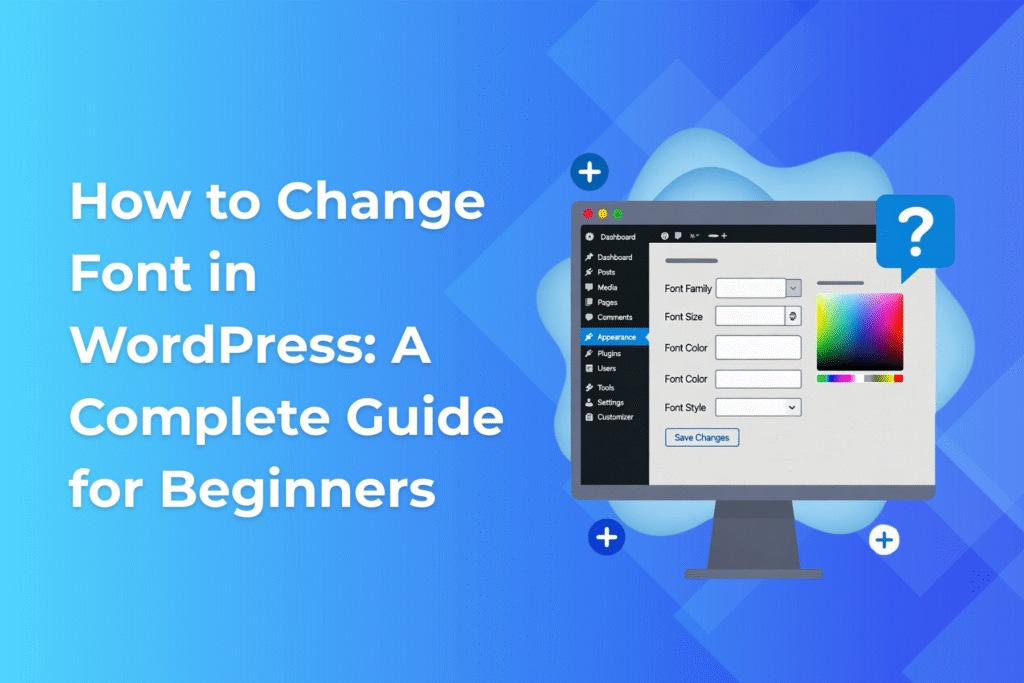
Your website font is one of the first impressions of your website; it helps to improve your design and experience of your site. We all know a good font can help to set standards for your website’s visual appeal, readability, and brand representation. Therefore, every one of us must learn how to change the font in WordPress. This is essential for all the website owners.
There are many scenarios in which this article can be helpful for you, whether you want to change your heading font, use Google Fonts, or upload your own font files. In this dedicated article, we will help you with customization of fonts using the WordPress dashboard, block editor, theme customizer, full site editor, fonts plugin, or custom CSS.
So let’s get straight into changing WordPress fonts and improve the entire website and its looks.

Markup for WooCommerce
The easiest way to markup your products in WooCommerce.
Why Fonts Matter for Your WordPress Website
Before we start changing the fonts, it’s always important to understand why a user chooses to change their website fonts. For a website, their choice of a unique font family and font style has a vital role in how their visitors get to consume the information and also have a connection to the brand.
If you have a well-chosen font, it provides you with added benefit. Here are some examples that can clearly make you understand all of them:
- Most of the websites that post tech content love to use sans-serif fonts. Why a sans-serif font? Because it is considered to be highly modern and clearly visible on the digital screen.
- A coffee shop owner chooses to use a custom font most of the time, handwritten. The reason behind this is that the owner prefers to provide a personal, unique, and friendly brand identity.
- If you are building a professional website, a developer chooses clean, standard fonts.
- It’s simple to give your brand your unique identity. With WordPress, you can easily customize your site’s font by using the WordPress block editor and site editor. Also, you can change the fonts for specific sections of your website, like headings, captions, buttons, widget titles, and text links.
Understanding WordPress Fonts
So, let’s understand What is a font? Fonts are styled letters or text that we generally see on our digital devices. In WordPress, fonts are so important that they can really differentiate between a basic website vs. a professional website. Before going to the guide on how to change the font in WordPress, let’s explore basic terms related to WordPress fonts:
- Font Family: These are the collection of fonts that have similar visual apperance.
- Font Style: The font style determines how your fonts look. Some styles are bold, italic, underlined, and so on.
- Font Weight: This defines the weight of the fonts, which is the thickness or boldness of your font.
- Font Size: This controls the size of your font and how big or small it should look.
- Line Height: The line height lets you control the space between the two lines of the fonts.
- Letter Spacing: It can help you customize the space that is present between the letters.
It’s important to understand these basic terms, as learning about them can help you have full control of the customization of your fonts.
How to Change Font Family in WordPress
In this tutorial, changing the font family of your WordPress blog is simple and helps you give a new personality to your website:
Method 1: Use the WordPress Theme Customizer
Changing Fonts in the WordPress Block Editor
The WordPress block editor, which many people also recognizeas the Gutenberg editor, is a powerful WordPress content editor. There are tons of features that are available with this editor, like editing posts or pages, and for this tutorial, the built-in typography controls are best suited to change fonts in WordPress.
These are the simple steps you should follow to change fonts using the block editor:
- First, open any post and pages from your WordPress Admin Panel.
- Now, you should click on any block you wish to modify.
- Next, use the typography settings that are on the right side of the bar.
- Finally, you can use the features for font size, font weight, line height, and text decoration.
The block editor is great, but it is not perfect. There are many themes that don’t allow you to change the font family directly. If it does support the editing, you can change the font for specific blog posts or pages. This is essential to have precise control for your text element and also protects your entire site.
Using the Full Site Editor
For the user using newer block themes, you can directly access the full site editor. Here are the steps one should follow:
- Using your WordPress Dashboard, navigate to the Appearance option.
- Now, select the Editor (or Site Editor).
- Next, open your styles panel.
- After this, select the Typography.
Finally, you can easily customize your font family, font size, font weight, letter spacing, and line height. When you choose to use the full site editor, you get the advantage of global settings. These settings can apply to different elements of your website, like body text, headings, buttons, and other elements.
Method 2: Using Your WordPress Theme Customizer
Accessing Theme Typography Settings
There is no necessity to install additional plugins because WordPress has a Theme Customizer. Many modern themes have their built-in customization option and typography options.
Here are some easy steps to access your theme’s customizer:
- First, open your WordPress dashboard.
- Now, you should find Appearance » Customize.
- Finally, you can find the typography option or font settings section.
Note: The location of the setting may be different based on the theme but you can easily find it.
After you access the WordPress customizer, you will be greeted with a dropdown menu that lets you select your preferred font. Many modern themes come with support for Google Fonts using you can choose from thousands of free font options.
Customizing Different Text Elements
There are many text elements in a WordPress theme. You can configure separate font styles for heading font and body text independently. Also, there are many themes in the marketplace that can help you edit widget titles, buttons, text links, and captions separately.
These are things that are included in the basic settings:
- Font family
- Font size
- Font weight
- Letter spacing
Before you make your changes final, it’s crucial to look at the preview. If the website doesn’t match your brand identity, you can change it easily.
Method 3: Installing a WordPress Plugin
Best Fonts Plugin Options
There may be a situation where your theme doesn’t support font settings, so rather than changing or switching to a new theme, you can easily install a WordPress font plugin. These plugins provide you the necessary font settings and provide you extra control for your font.
Here is the list of popular plugins:
- Easy Google Fonts: This plugin provides you with all of the Google Font library.
- Use Any Font: You can use this plugin to use custom fonts using the font files.
- Custom Fonts: This plugin allows you to add your fonts locally.
- Gutenberg Blocks with Font Awesome: This adds icon fonts into your block editor.
To install fonts using a plugin:
Here are simple steps to install fonts using your plugin.
- First, let’s install the plugin. You can navigate to Plugins » Add New from your WordPress Dashboard.
- Now, you can search for the fonts plugin that suits your needs.
- Select Install Now, and then you can activate fonts plugin.
- Finally, you can follow the plugin’s customization options and easily configure your typography on your WordPress site.
Configuring Font Plugin Settings
The next step after you activate fonts plugin is to configure it. There are many font plugins that add a new menu to your WordPress dashboard, making it easy to access your font settings.
Here are some steps you need to follow:
- First, select your desired plugin. You can get this font from Google Fonts or using custom font files.
- Now, you should assign your fonts to the font element. These font elements can be headings, paragraphs, buttons, and so on.
- After this, you can customize the font size, font weight, letter spacing, and other formatting options.
- Before you save the changes. remember to preview the changes on your WordPress website.
Method 4: Adding Custom CSS
When to Use Custom CSS Code
If you are someone who is familiar with CSS code, it can be the best approach to use custom CSS for typography customization. This method can be useful if the theme or font plugin lacks the level of flexibility you need.
Here are some common situations you may end up in and have to use custom CSS code on your website:
- If your theme or plugin doesn’t have flexible font options, you can use custom fonts.
- If you want to implement style-specific elements.
- if you want to make precise changes to letter spacing, line height, or other advanced settings.
- For a WordPress blog, you can use unique typography to make your website aligned with your brand ideology.
Adding Custom CSS to Your WordPress Website
WordPress is a wonderful CMS (content management system) that has an easy-to-add custom CSS functionality. You can customize the CSS code without risking problems with your theme files.
Here are some steps you can follow to add CSS codes:
- First, navigate to Appearance » Customize using your WordPress dashboard.
- Next, you should scroll down to Additional CSS.
- Now, you can paste the CSS code.
- Finally, You can click on the “Publish” button. Before you save the change you can take advantage of previewing the changes in real time.
Here are some simple CSS code that can help your change change the font for all headings:
h1, h2, h3, h4, h5, h6 {
    font-family: 'Your Font Name', sans-serif;
    font-weight: 600;
}
Here is the code to customize your body text:
body {
    font-family: 'Your Font Name', sans-serif;
    font-size: 16px;
    line-height: 1.6;
}
Using a Child Theme for CSS Customizations
A child theme is a theme that has all the functions of the parent theme but helps to make the editing process separate. Theme updates can be a burden for the font customization of the theme, so you should always use a child theme.
When you are adding font files and want to make typography changes, you must use a child theme because if you don’t, you may lose all the customization after theme updates.
Method 5: Uploading Custom Font Files
Preparing Your Font Files
There are many font styles with unique typefaces. If you want to present your brand in a unique way and the desired font is not available in Google Fonts or the standard web fonts library. You can utilize your custom font file or any premium font. You can easily upload your custom fonts on your WordPress site.
Before you install the font files, remember that these are the web-compatible formats for fonts:
- WOFF (Web Open Font Format)
- WOFF2 (newer, more compressed)
- TTF (TrueType Font)
- OTF (OpenType Font)
We suggest you follow global laws and never use any logos without any legal rights. Also, remember there are many fonts with the license specific to desktop and can’t be used. in web.
Steps to Install Custom fonts
Here is a manual method to install fonts:
- First upload your font file to your WordPress server. (Note: You can use FTP or your hosting file manager.)
- Now create a folder structure: /wp-content/uploads/fonts/.
- Finally, add your CSS code to use your freshly uploaded font.
This is an example of the CSS code you can use:
@font-face {
    font-family: 'Your Custom Font';
    src: url('/wp-content/uploads/fonts/your-font.woff2') format('woff2'),
         url('/wp-content/uploads/fonts/your-font.woff') format('woff');
    font-weight: normal;
    font-style: normal;
}
Conclusion
It doesn’t have to be hard to change the font in WordPress. You have a lot of choices for making beautiful typography that fits your brand. You can use the WordPress theme customizer, the block editor, a fonts plugin, or custom CSS.
Use the built-in typography settings in your WordPress theme or site editor to get started. If those don’t work for you, try a WordPress plugin that gives you more font choices. If you want full control over the font family, size, and other details, use custom CSS code. It’s not as scary as it sounds, and you’ll have complete freedom over how your site’s text looks.
Keep in mind that good typography is more than just how it looks. Your font choices should make the text easier to read, load quickly, and work on all devices. Try out different combinations of font families and sizes, but always put your visitors’ experience ahead of flashy design.
The right typography can make a big difference when you’re changing the look of your WordPress blog, updating your WordPress menu, or even redesigning your whole WordPress website. Now that you know how to change the font in WordPress, you can give your site the typography upgrade it needs. Your visitors will like the better reading experience, and you’ll love how professional your site looks with the right fonts.
Markup for WooCommerce
The easiest way to markup your products in WooCommerce.
Frequently Asked Questions
How can I change the font size on my WordPress website?
For Block Editor, you can simply click on any block and easily change font size using the sidebar settings. Alternatively, you can utilize Appearance » Customize.
What’s the best way to select the right font for my WordPress blog?
The right font for your brand is always clear and has an easy-to-read font.
Can I use new fonts that aren’t included in my WordPress theme?
Yes. You can easily add new fonts using a plugin, a page builder, or by manually adding services like Google Fonts.
How do I use Google Fonts in my WordPress site?
The easiest way is with a plugin like “Easy Google Fonts” or “OMGF.” Many page builders also have Google Fonts built-in for you to select.
Are Google Fonts safe and fast to use on WordPress?
Yes, they are safe and very popular. To make them fast, use a plugin that hosts the fonts locally on your server instead of loading them from Google.
Can I change the font style or size in my WordPress menu?
Yes. This is usually done in the Customizer (Appearance >> Customize) under “Menus” or “Additional CSS.”
Do my font choices affect website performance or SEO?
Yes. Using too many fonts or font weights can slow your site down, which indirectly affects SEO. Stick to 2-3 fonts and only the font weights you need for the best performance.
